
When I was a little girl, I had a tree who was my friend. It grew in our front yard, boasting delicate white bark and gently sloping branches that my sister and I could easily climb. We would sit high above the ground, reaching out to its thin, gracefully hanging branches to fashion crowns and belts. We made “porridge” out of its seeds and played for hours under the safety of its watchful care. I named the tree Willow, even though I now know it was a weeping birch. I loved that tree. To my child’s eye, it had a spirit and an obvious presence.
Maybe you, too, have felt that way about a plant? This belief that plants possess a spirit or soul is part of a concept called animism.
A World That Breathes With Us
Animism is one of humankind’s oldest forms of worship. While some define it simply as the belief that objects and creatures possess a distinct spiritual essence, author Robin Wall Kimmerer invites us deeper. She describes animism not merely as a belief system, but as a relational worldview centered on reciprocity. In this view, the natural world is a community of intelligent beings and kin worthy of respect, rather than a collection of mere objects or resources.
Trees are perhaps our most profound teachers in this regard. Around the world, they are revered as sacred —from the Shaman Trees of Siberia to the Wishing Trees of Norway, China, and Thailand. In many cultures, the "Tree of Life" serves as the central nervous system of the cosmos, connecting all forms of creation.
The Poverty of Materialism
Animism differs significantly from the common Western philosophy of Materialism, which asserts that the “real” world consists only of physical matter. Materialism suggests that acquiring goods—wealth, status, and luxury—is the key measure of success.
Currently, many in the West find themselves "stuff-rich" but soul-poor. We are deeply impoverished in the things that truly matter: community, connection, and meaning. This relentless consumerism has driven our world toward environmental and social crises. To find our way back "home," we can look to our ancestors. Somewhere in your lineage, there were ancestors who knew the plants by name. Reconnecting with herbs isn't just a hobby; it’s a reclamation of your birthright.
The Sentience of the Green World
Over my decades as an herbalist, I have come to believe that plants are truly sentient. They are much older than humans, having inhabited the Earth long before animals arrived, and they have developed sophisticated ways of being.
Plants are constantly communicating, and they do so with a generosity that is beyond measure. They interact through complex chemical signals called volatile organic compounds (VOCs) to alert their neighbors to danger. Through the "Wood Wide Web"—the underground mycorrhizal networks of fungi—they perform incredible feats of community care:
Warning neighbors of herbivore attacks so they can bolster their chemical defenses.
Alerting each other to threatening pathogens or impending droughts.
Recognizing kin, often funneling extra nutrients to younger or weaker plants of their own species.
Adapting continually to the information they receive from the vibrant community around them.
When we realize that every forest and garden is a buzzing hub of mutual support, we begin to see that we aren’t just observers of nature—we are invited to be part of the conversation, too. By recognizing the sentience in the green world, we open the door to a relationship that many of us haven’t felt since we were children.
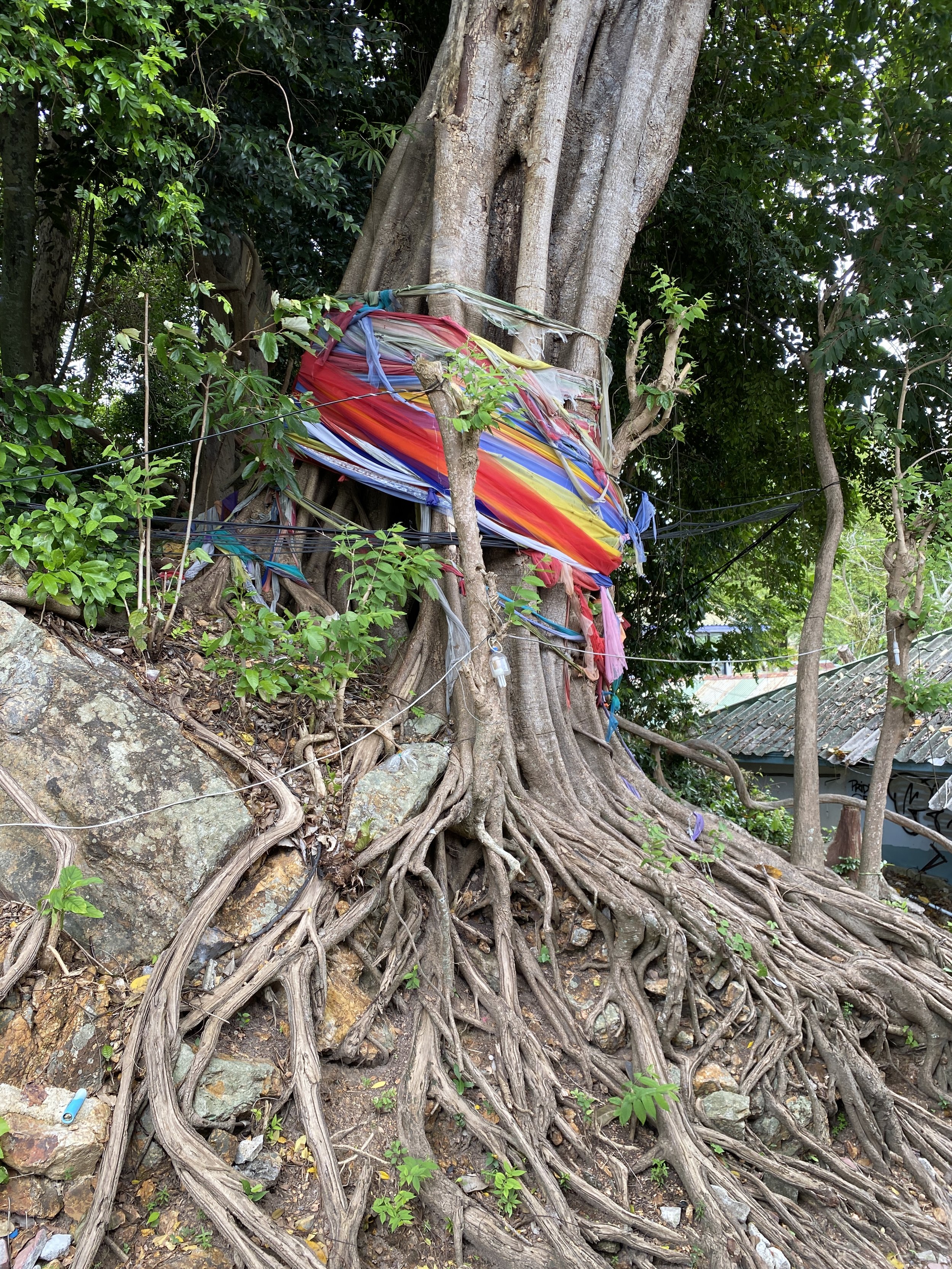
A sacred tree in Thailand
Join the Conversation
I would love to hear about your own "Willow." Did you have a specific plant friend as a child—a tree that held your secrets or a patch of clover where you felt safe?
Perhaps that connection has arrived more recently: a resilient dandelion pushing through the sidewalk, a morning greeting from the rosemary on your windowsill, or a moment of quiet awe in the woods.
Reclaiming our place in the web of life starts with a single story. I’d love to know:
What was the first plant you ever "met" or loved?
Do you have a favorite way of listening to the green world today?
Please share your experiences and reflections in the comments below. Let's honor our plant kin by weaving our stories together—I can't wait to read yours.